

If a stainless steel gas pressure regulator starts creeping upward, loses pressure under load, chatters, or leaks from its bonnet vent, the fault is often related to contamination, incorrect sizing, a damaged seat, a sensing-element issue, or an installation problem. The safest approach is to identify the symptom, isolate the gas supply, verify the actual operating conditions, and follow the manufacturer's approved service procedure—not simply turn the adjustment knob harder.
A pressure regulator is a small component with a big responsibility. In laboratories, semiconductor gas systems, pharmaceutical facilities, hydrogen projects, and industrial gas lines, it reduces a variable upstream pressure to the delivery pressure required by downstream equipment.
When regulation becomes unstable, the consequences can include inaccurate analytical results, interrupted production, damaged instruments, and overpressure hazards. This guide walks through eight common regulator problems, what they usually mean, and the selection and maintenance decisions that help prevent them.
01How a Stainless Steel Gas Pressure Regulator Works
Most direct-acting pressure-reducing regulators work through a balance of forces. An adjusting spring applies force to a diaphragm or piston, which moves a valve poppet relative to its seat. As downstream pressure changes, the sensing element moves and adjusts the opening to help maintain the selected delivery pressure.
Pressure is reduced as gas passes through the throttling restriction, but stable regulation comes from the mechanical feedback between the spring, sensing element, and valve—not from throttling alone. Some designs are diaphragm-sensed, some are piston-sensed, and larger process regulators may use a separate pilot. These designs should not be treated as mechanically identical.
Two performance terms are especially useful when troubleshooting: droop means outlet pressure falls as flow demand rises; supply pressure effect (SPE) means the regulated outlet pressure changes when inlet pressure changes. Neither should automatically be mistaken for a leaking valve seat.
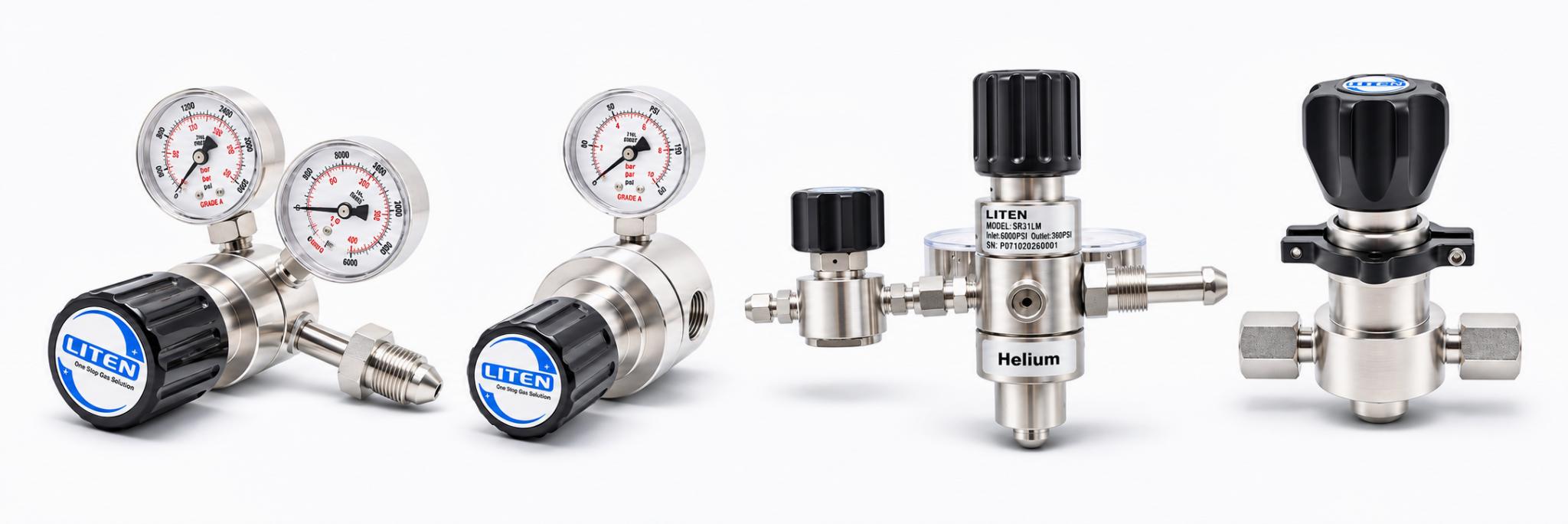
02Eight Common Pressure Regulator Problems
Safety first: These checks are for trained personnel. For toxic, flammable, oxygen, or other hazardous gas service, isolate the system using its approved shutdown procedure and make the equipment safe before inspection. Do not disassemble or tighten pressure-containing parts while pressurized.
1. Outlet Pressure Keeps Rising (Pressure Creep)
What you'll notice: The downstream pressure continues to rise after flow stops, even though the adjustment setting has not changed.
Likely causes: A particle trapped between the poppet and seat, seat wear, surface damage, or a sealing defect can allow inlet gas to leak through a valve that should be closed.
What to check: Remove the regulator from service; inspect the upstream filtration, seat and poppet using an approved maintenance procedure. Replace damaged parts with compatible manufacturer-approved components, then leak-test and function-test before returning the unit to service. Confirm that downstream equipment has suitable overpressure protection.
2. Pressure Drops Sharply When Flow Starts (Excessive Droop)
What you'll notice: The delivery pressure looks correct with no flow but collapses when the instrument or process starts drawing gas.
Likely causes: Flow demand may exceed the regulator's operating capacity. Other possibilities include inadequate inlet pressure, a blocked filter, excessive pipe pressure drop, or an undersized connection.
What to check: Compare actual flow and inlet-pressure conditions with the regulator's flow curve and required outlet pressure. Check upstream restrictions and the gas source. If inlet pressure varies substantially, a suitable two-stage regulator or other low-SPE arrangement may improve stability; the right choice depends on flow, gas, and application requirements.
3. The Pressure Gauge Reads Zero or Barely Moves
What you'll notice: Gas may be present, yet the inlet or outlet gauge shows little or no pressure.
Likely causes: The gauge may have an unsuitable range, incorrect units, a blocked pressure port, a closed isolation valve, or an internal failure. Do not assume the system is unpressurized because one gauge reads zero.
What to check: Verify pressure with a properly rated, calibrated test instrument. Select the gauge range to keep the normal operating point in a readable portion of the scale; approximately twice the typical operating pressure is a common starting point, not a universal rule. Replace or calibrate a suspect gauge according to its specification.
4. The Relief Valve Opens or Gas Discharges Unexpectedly
What you'll notice: A relief device lifts, vents repeatedly, or leaks after a period of normal operation.
Likely causes: True downstream overpressure from regulator creep, an incorrect relief setting, leakage at the relief seat, thermal expansion, or material incompatibility may be involved.
What to check: Treat the event as a protection-system warning, not a nuisance to silence. Verify the actual pressure, determine why it exceeded the intended limit, and have the relief device evaluated by qualified personnel. The discharge location and capacity must be safe for the process gas. A built-in relief feature is not an automatic substitute for a properly designed system relief device.
5. Whistling, Chattering, or a Vibrating Gauge Needle
What you'll notice: The regulator whistles, rattles, or hunts between pressure readings, especially as demand changes.
Likely causes: Unstable flow, excessive pressure drop, an unsuitable regulator size, rapid cycling, a worn sensing element, or resonance in the connected piping can create oscillation.
What to check: Record inlet pressure, outlet pressure, and flow together; compare them with the manufacturer's operating envelope. Check mounting and piping support, then review sizing and internal condition. Do not increase inlet pressure simply to suppress noise.
6. Gas Leaks From the Bonnet or Vent Port
What you'll notice: Gas escapes continuously from an opening in the regulator spring housing or bonnet.
Likely causes: In a non-self-relieving diaphragm regulator, this may indicate a damaged diaphragm or failed diaphragm seal. However, some self-relieving designs intentionally vent under defined operating conditions.
What to check: First identify the regulator's exact venting design. If the discharge is abnormal, isolate the equipment and arrange inspection by qualified personnel. For hazardous gases, ensure any required captured-vent system routes possible leakage to an approved safe location.
7. Turning the Adjustment Knob Produces No Gas Flow
What you'll notice: The handle turns, but the outlet pressure does not increase.
Likely causes: The cylinder or upstream valve may be closed, the source may be empty, an inlet filter may be obstructed, or an internal spring, stem, or valve assembly may have failed.
What to check: Check source pressure, upstream shutoff positions, approved isolation points, and filter condition before assuming the regulator mechanism is defective. Service internal parts only in accordance with the manufacturer's instructions.
8. External Leaks at Fittings, Gauges, or the Regulator Body
What you'll notice: A leak test identifies gas escaping at threaded joints, tube fittings, a gauge connection, a relief component, or another pressure boundary.
Likely causes: A damaged gasket, incorrectly assembled fitting, incompatible seal material, corrosion, excessive mechanical load, or repeated thermal cycling may be responsible.
What to check: Isolate and depressurize using the approved procedure. Inspect and replace affected seals or components, reassemble to the specified instructions, and retest using a leak-detection method approved for the gas. Never use an open flame to locate a leak or use abrasive paper on a precision valve seat unless the manufacturer specifically authorizes that repair.
03Quick Reference Table: Symptom, Cause, First Action
| Symptom | Possible cause | First safe action |
|---|---|---|
| Outlet pressure creeps up | Contaminated or damaged seat | Isolate; inspect seat and upstream filtration |
| Pressure falls under load | Undersizing, poor supply, restriction | Compare actual flow with regulator flow curve |
| Gauge reads zero | Wrong range, blocked port, failed gauge | Verify with a rated, calibrated instrument |
| Relief device vents | Overpressure, setting or seat issue | Confirm pressure and investigate protection event |
| Chatter / needle flutter | Flow instability, resonance, wear | Record pressure and flow; review sizing |
| Bonnet vent leaks | Diaphragm damage or designed venting | Identify regulator type; isolate abnormal leak |
| No output when adjusted | No source pressure, blockage, internal failure | Check supply and isolation first |
| External leakage | Connection, seal or pressure-boundary issue | Depressurize, repair correctly, leak-test |
04Lifecycle Maintenance: Prevent Problems Before They Stop Production
A reliable regulator program begins long before the first maintenance visit. Material selection, regulator sizing, installation cleanliness, monitoring, and approved repair practices all influence how long a regulator performs as expected.
Stage 1 — Select Materials for the Actual Gas
SS316L is widely used for many high-purity gas components because of its corrosion resistance and suitability for precision cleaning. But 316L is not compatible with every gas or chemical environment. The correct wetted materials also depend on moisture, impurities, temperature, pressure, and the elastomers or seat polymers inside the regulator.
Before specifying a regulator, confirm the gas composition, maximum inlet pressure, required delivery range, flow demand, ambient conditions, applicable cleaning requirements, and wetted-material compatibility. Corrosive, toxic, oxidizing, and hydrogen service may require dedicated designs and additional engineering review.
Stage 2 — Match the Internal Design to the Duty Cycle
Diaphragm-sensed and piston-sensed regulators each have useful operating ranges; neither is universally superior. High purity, high pressure, large pressure differentials, flow stability, and adjustment frequency can favor different configurations. Evaluate the regulator's pressure rating, seat design, flow curve, SPE, droop, and leak-tightness specification together.
Where downstream pressure must remain especially stable as cylinder pressure falls, consider a suitable two-stage design or two properly selected regulators in series. Choose filters with a specification that protects the seat without starving the process of flow.
Stage 3 — Install Cleanly and Without Unnecessary Stress
Particles, metal shavings, incorrect sealing practices, and stressed piping can shorten regulator life. For high-purity service, use a documented cleaning, assembly, and leak-testing procedure appropriate to the gas. ASTM A380/A380M provides general practices for cleaning and passivation of stainless steel; it does not mean every assembled regulator should be exposed to acid treatment.
- Keep protective caps in place until installation; inspect connections for visible damage and contamination.
- Use the gas-approved purge and commissioning procedure; do not assume one purge gas is appropriate for every application.
- Install a compatible upstream filter where required, with sufficient flow capacity.
- Support tubing and connected equipment so mechanical load is not transferred to the regulator.
- Follow the exact fitting assembly and torque specifications rather than applying one generic torque value to every connection.
Stage 4 — Monitor Trends, Not Just One Pressure Reading
For critical installations, record inlet and outlet pressure under both static and flowing conditions. Repeat measurements at comparable flow rates so gradual changes are visible. Frequent unexpected relief events, increasing droop, new vibration, or recurring leakage are reasons to investigate before the next routine shutdown.
Pressure sensors and plant monitoring systems can help flag unusual trends, but sampling intervals and alarm thresholds should be engineered for the system. A single universal rule—such as servicing all regulators every 12 or 18 months—cannot replace the manufacturer's recommendations and the site's risk assessment.
Stage 5 — Repair, Test, or Replace
Many regulators can be serviced with manufacturer-approved replacement seats, diaphragms, springs, and seals. Others, particularly those in high-purity or hazardous service, may need replacement rather than field refurbishment. After approved maintenance, document the parts used, leak-test results, pressure-setting checks, and the return-to-service authorization.
Do not apply general valve hardfacing, machining, or pressure-relief-valve test criteria to a compact gas pressure regulator without a manufacturer-approved procedure. For example, API 527 addresses pressure relief valve seat tightness and is not a universal acceptance standard for pressure-reducing regulators.
05Understanding Lifecycle Cost (LCC)
Purchase price is only the first line of a regulator's real cost. For engineers and procurement teams, lifecycle cost is a more useful way to compare equipment that will remain in service for years:
| Cost category | What to include in the comparison |
|---|---|
| Purchase | Regulator, options, testing, documentation, installation |
| Operation | Process losses, utilities, routine inspection labor |
| Maintenance | Spare parts, calibration, planned shutdown work |
| Failure | Unexpected downtime, scrapped batches, emergency repair |
| End of life | Safe removal, disposal or approved replacement |
For example, an inexpensive regulator may cost more over time if it needs frequent service or causes repeated process interruptions. A higher-specification regulator may be the better choice when its actual materials, sealing performance, supportability, and inspection requirements match the duty. The comparison should use site-specific costs and verified service history—not invented savings percentages.
06Four Safety Rules That Matter Every Time
- Keep it clean. Prevent dust, oil, grease, and other contaminants from entering the gas path. Oxygen equipment requires particularly strict oxygen-compatible cleanliness and materials.
- Protect every seal. Use the correct connection type, compatible seals, and approved assembly procedure. Leak-test before commissioning.
- Match the gas. Never interchange regulators simply because the inlet threads appear to fit. Confirm gas-specific service, materials, ratings, and cylinder connection standards.
- Pressurize slowly. Follow the equipment manufacturer's startup sequence, stand clear of the pressure path, and open cylinder valves in a controlled manner. Rapid pressurization is particularly hazardous in oxygen service.
Important: Do not heat a frozen regulator with an open flame or improvise repairs on a pressurized assembly. Stop and follow the site's approved procedure. If the media is toxic or flammable, leak and vent management must be included in the safety design.
07Putting It Together
A practical troubleshooting sequence is simpler than it first appears: confirm the symptom → compare the regulator with the application → isolate safely → inspect the most likely cause → test before restarting. In many cases, a regulator problem begins upstream—with particles, inadequate flow capacity, an unsuitable connection, or an unstable gas source.
The best preventive maintenance strategy is not to replace everything on a calendar. It is to combine correct selection, clean installation, useful pressure records, and an inspection program appropriate to the service risk.
Need Help Selecting a Gas Pressure Regulator?
LITEN supplies stainless steel pressure regulators and gas-line components for laboratory, industrial, and high-purity applications. If you are comparing a single-stage and two-stage design or replacing an unstable regulator, share the gas type, inlet pressure range, desired outlet pressure, flow rate, connections, and application. That information is the starting point for a meaningful technical review.
Contact LITEN for Product Selection →08Frequently Asked Questions
What causes pressure creep in a gas regulator?
Pressure creep generally means gas is passing a valve seat that should be closed. Dirt, seat wear, or sealing damage are common causes. Investigate the seat and filtration, and verify downstream overpressure protection.
What is the difference between pressure creep and droop?
Creep is an unwanted increase in outlet pressure under low-flow or no-flow conditions. Droop is a decrease in outlet pressure as flow demand rises. They point to different troubleshooting paths.
Should I choose a single-stage or two-stage regulator?
A single-stage regulator is often suitable where source pressure is relatively stable or outlet-pressure sensitivity is modest. A two-stage arrangement can reduce outlet-pressure variation as cylinder pressure falls, especially in low-flow analytical applications.
Does every regulator need a built-in safety relief valve?
Not necessarily. The downstream system must be assessed for overpressure risk, and any required protective device must be correctly selected, sized, and discharged to a safe location. An integral relief feature may not satisfy that requirement.
Is SS316L suitable for every specialty gas?
No. SS316L is common in high-purity equipment, but compatibility also depends on the gas, moisture, temperature, pressure, and internal seal materials. Always verify the complete wetted-material specification.
How often should a pressure regulator be serviced?
There is no reliable universal interval. Use the manufacturer's guidance together with gas hazard, operating cycle, contamination risk, trend data, and the site's maintenance policy.